Who are we? We are our stories.

Monday, November 22, 2021

The Old House at 1410 Oakwood

Our home began life in 1907 as a 12' x 16' hunting shack. The town grew out and eventually ate Oakwood Park. Duck hunting and pan fishing were replaced by water skiing, wave runners and other cursed petroleum powered water sports.

Over time at least five one room additions were made to the old shack at 1410 - and it is still a small roomed modest home. Even the stairs down to the lower walkout level are in their third location. 1410 is drafty, wobbly and wonky, but we love it and continuing the tradition, we continue to pour money into remodeling and keeping it dry and upright.
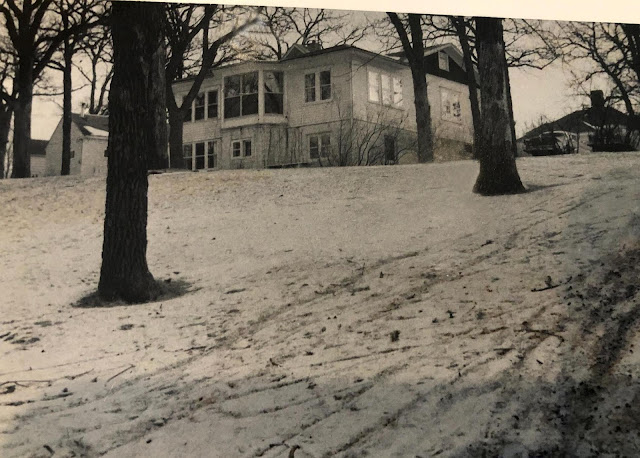

By chance, my close friend Chesterman grew up at 1410 and he sent me this photograph of his childhood home. It is barely
recognizable. Even the terrain has changed with stone retaining walls and such (and a growlery and water feature).
Over the years the house has had walls moved and removed, a new kitchen and bathrooms, new mechanicals - been re-sided with cedar tongue-in-groove and shakes, all the windows replaced, a couple with doors accessing a lattice covered 16' x 42' deck. In hindsight, moneywise, little of this made sense, but it has been our home for 35 years and it is where our heart is.


Circles and cycles - far end, John Chesterman heading the table at his childhood home. 


Wednesday, November 10, 2021

Rocks and Water

Likely last warm day of the year ... so like most sane people, I moved rocks. 

As I said in my previous posting, wild rocks can be hard to herd - difficult to make them behave. I placed, replaced, adjusted, readjusted the rocks ... then stepped back to look and did it all over again maybe 47 times.

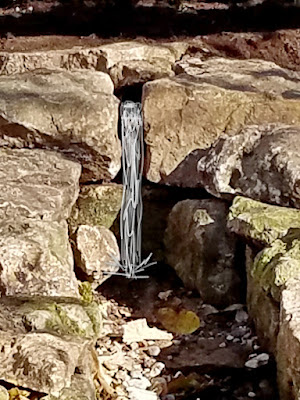
This is what I finally ended up with - sketched in the potential waterfall. I have the water shut off and the reservoir tank drained for the season so we will have to wait for Spring to see what it actually looks like functioning.

Is it a river flowing out of the northern boreal forest dropping off the Precambrian bedrock escarpment into a deep eroded runnel stream, falling off a spectacular shoreline cliff into the cold waters of Gitchigumi over centuries to seep deep into a subterranean aquifer?

Or is it a rinky-dink rock garden rivulet draining into a concealed 40 gallon galvanized cow tank with a plastic lift pump? 

Either way - circles and cycles. 


Next, black landscape foam adhesive to anchor the smaller rocks, hard pack a mix of wet dirt and moss into the cracks. Then plant a low growing grassy carex, Pennsylvania Sedge, and maybe some Blue-eyed Grass on the "headlands." 

"Give me a lever long enough, a place to stand, and I will move the world."  - Archie Medes
"Moving rocks so you don't have to," - Gunnar Berg

Tuesday, November 2, 2021

Waterfall - After Spring Migration?

I have been looking for low, flat weathered rocks of the correct color while at our other home in Lanesboro. Not much luck. I then realized I have enough rocks although they are 6" thick. I was imagining a 6" waterfall as it is now. Hell, why not a 12" waterfall - more of a statement instead of a trickle. 

Here is a sketch of my planned upper falls. Of course it will only vaguely resemble this. It is tough herding wild rocks because they tend to have a mind of their own. 


Sunday, October 24, 2021

A Mountain Stream

Welcome, you are probably the few who would understand this, comprehend the insanity. This is a top view of the top portion of our water feature stream. The water use to squirt illogically from between and under a rock pile in the water course. Now it originates from snow melt high in the mountains - on the upper left under the yew bush. It flows down a narrow canyon to the cliff edge and drops in a picturesque tourist favorite 5" waterfall.

Actually the water recycles in from the reserve tank in a flexible pipe right before it falls into the existing water course - which is currently filled with oak leaves. Also I need to spread the fake stream width just a little - jack the rocks apart a bit before the stream falls over the edge, and next Spring plant some giant doug firs on the mountain slopes. Or a few stonecrop sedums.


Obsessively yours, 
Gunnar

Tuesday, October 5, 2021

Spotted Towhee

I have seen an Eastern Towhee in our yard once thirty years ago. Towhees are about as dressed up as a sparrow can get, so when a pair showed up today I was excited, snapping photos with one hand, calling Lorna on the cell with the other. Fixated on the male😖, I got some nice shots, as did Lorna.

(Addendum: This has proven to be an out of range Spotted Towhee.)


Lucky boy, 
Gunnar

Saturday, September 4, 2021

Labor Day Birds

 Labor Day. Many of the family young bucks labored on resurfacing our driveway while I putzed in the garden. Technically our neighbor Tim may not be family, but he is in the true sense. He has stood up in family weddings and is there when we need him. As the project wounded down he came down to collect his pay - two beers. As we talked I took photos and identified the birds for him. Here are some of them, including a first of season Cape May Warbler.


Cape May


- Gunnar

Thursday, August 26, 2021

Raining Warblers (and a Vireo or two)

A small number of the hundreds of photos I took on 8/25/2021 at the water feature of 1410 in the Oakwood neighborhood of Albert Lea, Minnesota.


Yellow-throated Vireo


Spring Warbler migration progress can be monitored online by the satellite images. Fall is difficult to know exactly when they will come through, but I believe more consistent for us year to year. In Spring they seem to be in a nervous hurry to get to breeding grounds. Some years they catch a front and blow right over us. In Fall they seem maybe a little more laid back, just resting, feeding, moving on down the line to the tropics. Nothing  scientific, just a feeling I get watching them. 

- Gunnar

Tuesday, August 24, 2021

More Warblers From Yesterday.


Golden-winged Warblers

This is my favorite seasonal backyard Warbler. It is beautiful and becoming rarer. 😢Historically they nested in the Appalachians and northern tier states west into Minnesota. Now due to habitat loss and a complicated relationship with its cousin the Blue-winged Warbler, it nests primarily in northern Minnesota.  

If migrating birds can remember and return to the same local nesting location, maybe they remember the pit stops along the migration route. Maybe? For whatever reason, we have gotten them every Spring and Fall for a number of years. Yesterday they showed up right on schedule. A couple of rest days and they will be on their way again to Central America. 


Amazing 31oz bits of blood, bone, gristle and feather.

-  Gunnar